
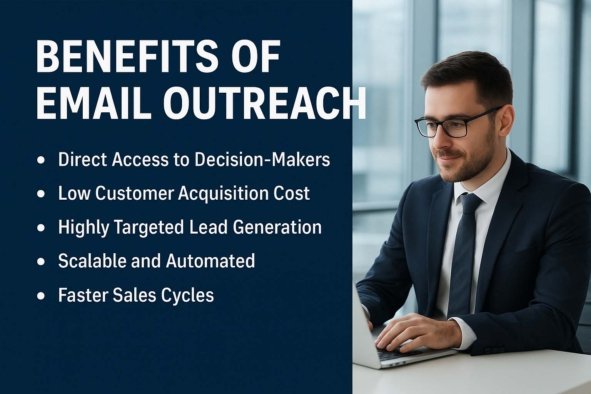
This is a structured, repeatable Email Outreach framework you can use to run outbound email campaigns for your SaaS.
A. Preparation & Strategy for Email Outreach
- Define Your ICP (Ideal Customer Profile)
- Industry, company size, revenue, tech stack, geography for Email Outreach
- Key personas / job titles: e.g., Head of Engineering, Product Manager, CTO, Operations Lead
- Pain points / trigger events: e.g., scaling issues, inefficient workflows, recent funding, growth stage
2. Build & Clean Your Prospect List for Email Outreach
- Use high-quality tools (Apollo, LinkedIn Sales Navigator, Crunchbase, etc.)
- Verify email addresses (using tools like NeverBounce, Hunter)
- Segment list into smaller, tightly-targeted cohorts (e.g., by pain point, size, persona) — smaller cohorts often outperform large batch sends
3. Set Up Technical Infrastructure for Email Outreach
- Domain setup: use a separate domain or subdomain for cold outreach
- Ensure proper authentication: SPF, DKIM, DMARC
- Warm up the sending domain over time
- Use an outbound email tool that supports personalization and sequence automation
4. Craft Messaging Strategy
- Develop your “hooks”: what angle you will use (problem, timeline, numbers, customer success)
- Value proposition: what unique value your SaaS gives
- Social proof: mention customers, case studies, or results
- Call to action (CTA): what you want them to do (book demo, quick call, share feedback)
B. Sequence Design & Cadence for Email Outreach
Design a multi-touch sequence. Here’s a sample 6-step cadence:
| Step | What You Send | Focus / Goal |
|---|---|---|
| 1 | Initial Email | Intro + Hook (e.g., problem / timeline) + Value proposition + Soft CTA (e.g., “Would you be open to a short call?”) |
| 2 | Follow-up 1 | Reference the first email, add a datapoint or insight, re-state value, ask a question or offer help |
| 3 | Follow-up 2 | Provide social proof or a case study, show how someone similar has benefited, CTA for meeting or call |
| 4 | Follow-up 3 | Add more personalization, maybe a one-pager or insight, “just checking in” tone |
| 5 | Break-up / Last Touch | Offer last opportunity: “If now isn’t right, can I check back in X months?” or “Is there someone else on your team I should talk to?” |
| 6 (Optional) | Re-engagement after a while | New insight, product update, relevant content (whitepaper, report) + soft ask to reconnect |
- Space these out properly: commonly 3–7 days between sends depending on sequence.
- Use multi-channel touches if possible (e.g., LinkedIn + email).
C. Personalization & Copywriting
- Personalization: Use prospect’s name, company, a recent trigger (funding, blog post, hiring, tech change, expansion).
- Conciseness: Keep emails short — most high-performing campaigns use around 50–125 words or even shorter.
- Structure:
- Hook / context
- Value proposition
- Social proof / proof point
- CTA
- Tone: Human, helpful — not overly aggressive, unless that’s your style.
D. Follow-Up Strategy
- Don’t stop after one email. Data shows that many replies come in follow-up steps.
- Each follow-up should add something new or valuable (insight, proof, question) — not just “Did you see my last email?”
E. Measurement & Optimization
Track metrics at each stage:
- Deliverability / Bounce Rate
- Open Rate
- Reply Rate (total replies + positive replies)
- Meeting / Demo Booked Rate
- Conversion Rate (from replies to qualified opps)
Run A/B tests on:
- Subject lines
- Hooks / message angles
- Email length
- Cadence (number of touches, spacing)
- Timing (day of week, time of day)
Review and iterate:
- Analyze which segments (ICP, hook) perform best
- Drop or improve underperforming sequences
- Scale what works; pause or rework what doesn’t
F. Scaling & Multi-Channel Integration
- Once a sequence works reliably: scale by replicating similar sequences for other ICP cohorts.
- Integrate with LinkedIn outreach: sending a connection + message, or just “profile visits + email” tends to improve response.
- Consider phone touches or SMS if your ICP is okay with that.
- Always maintain list hygiene and domain health when scaling.
Add a Comment
You must be logged in to post a comment